 We're open every day from 10 AM to 4 PM!


This 1935 Packard 120 Convertible Coupe is a delightful example of 1930s American roadster styling, combining elegant open-body coachwork with Packard’s renowned engineering quality. Donated to the Motor Museum of Western Australia, it is thought to have originally come from Bridgetown and was purchased in York in 1966.
Packard’s Move Downmarket
Packard had long built prestige motor cars for the upper end of the market, but the Depression created demand for a more attainable Packard. In 1935, the company introduced the 120—also known as the One-Twenty—as its first model priced below US$1,000, creating a successful “junior” Packard range.
The strategy worked remarkably well. Packard sold about 25,000 examples of the 120 in its first year, compared with around 7,000 of all other Packard models combined, helping make Packard the twelfth-largest American carmaker that year.
“The Car of the Twelve Firsts”
Packard promoted the 120 as “The car of the twelve firsts.” According to the company’s story, it purchased twelve leading competitor cars, tested them thoroughly, identified their best features, and designed the 120 to match or exceed those benchmarks.
The result was a modern, well-equipped car for its price. The 120 featured independent “Safe-T-Flex” front suspension, hydraulic brakes, a hypoid bevel final drive, and a three-speed synchromesh gearbox—features that were not yet fitted to Packard’s larger Senior models.
Straight-Eight Performance
At the heart of the 120 is Packard’s 256 cubic-inch side-valve straight-eight engine. In 1935 it produced 110 horsepower at 3,850 rpm and drove the rear wheels through a three-speed manual gearbox.
The engine used a one-piece cylinder block and crankcase, with a five-main-bearing crankshaft, alloy cylinder head, and dual-choke carburettor. For 1936, Packard enlarged the engine to 282 cubic inches and increased output to 120 horsepower.
Classic Open Motoring
This Convertible Coupe captures the romance of pre-war open motoring. Its low, sweeping bodywork, twin fender-mounted spare wheels, and rear “dickie” or rumble seat give it the unmistakable appearance of a 1930s roadster.
The rumble seat provided occasional open-air accommodation for two additional passengers, while the side-mounted spare wheels added both practicality and visual presence. Together, these details make the car a striking representation of Packard’s ability to combine luxury-car craftsmanship with sporting style.
A Western Australian Story
Thought to have originally come from Bridgetown, this Packard was purchased from York in 1966. Its long-term presence in Western Australia makes it an especially valuable part of the Motor Museum of Western Australia’s collection.
The car has been generously donated to the Motor Museum of Western Australia, where it can now be enjoyed by visitors as an important example of Packard’s transition from exclusive luxury motoring to a broader, still premium, market.
On Display For A Limited Time
Please note that many of the vehicles displayed at the Motor Museum of Western Australia, are on loan to us from private collectors and enthusiasts.
Our displays change regularly to showcase a wide variety of vehicles and motoring history, so if you want to experience these rare and extraordinary cars in person, we encourage you to visit us soon.
Whether you are a passionate car lover or simply curious about automotive heritage, the Motor Museum offers a unique and engaging experience that evolves throughout the year.
Visit Us
For more information about visiting the Motor Museum of Western Australia, including opening hours, ticket prices, and current exhibitions, please visit our Visitor Information page or contact us directly.
We are open every day from 10 AM to 4 PM (closed Christmas Day) at Whiteman Park, 233a Drumpellier Drive, Whiteman, WA 6068.
Tickets can be purchased online for your convenience or directly at the museum entrance.
For enquiries, group bookings, or special events, please call us on (08) 9249 9457 or email manager@motormuseumwa.com.au.
We welcome visitors of all ages and motoring interests and look forward to sharing Western Australia’s rich automotive history with you.
Discover More
-
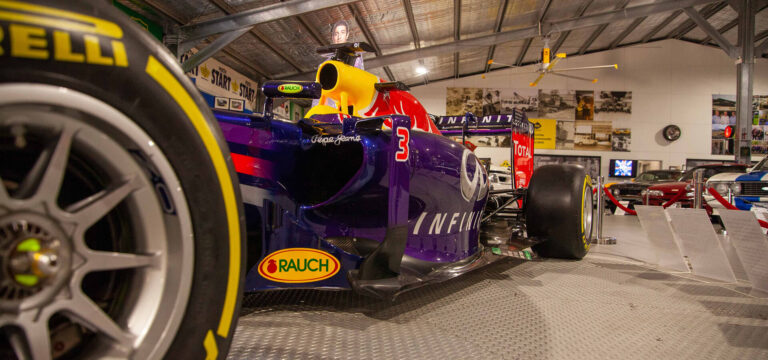
Red Bull F1 Racing Car
Daniel Ricciardo’s very generous offer to favour the Motor Museum with a long term loan of Red Bull RB 10, the car..
-

1965 Chevrolet C2 Corvette Stingray
Discover a rare 1965 C2 Corvette Stingray roadster with original fibreglass panels, 396 ci 425 hp Big Block power and exceptional originality.
