 We're open every day from 10 AM to 4 PM!


The 1965 Chevrolet C2 Corvette Stingray is one of the most celebrated American performance cars of the 1960s. This exceptionally original 396 ci, 425 hp Big Block roadster represents a rare and highly desirable configuration of Chevrolet’s second-generation Corvette.
A New Era for Corvette
The C2 Corvette, introduced for 1963 as the “Sting Ray,” brought a dramatically sculpted body, hidden headlamps, and, in a first for Corvette, independent rear suspension. Its design is widely credited to Bill Mitchell and Larry Shinoda, and it established the aggressive styling that made the second-generation car an enduring icon.
By 1965, the Sting Ray had matured into a serious performance machine. Chevrolet offered a range of 327 cubic-inch small-block V8s, but the major news arrived mid-year: the first Big Block Corvette engine, the 396 cubic-inch Mark IV V8.


The 396 Big Block
This car’s 396 ci V8 is the L78 version, factory-rated at 425 horsepower at 6,400 rpm and 415 lb-ft of torque at 4,000 rpm. It used an 11:1 compression ratio, mechanical valve lifters, a high-lift camshaft, a four-barrel Holley carburettor, forged internal components, and four-bolt main bearing caps.
The L78 was a one-year-only Corvette option, introduced during the 1965 model year. Chevrolet built approximately 2,157 L78 Corvettes, of which about 1,041 were convertibles—making this roadster body style especially significant.
Performance Package
The 396/425 option was more than an engine upgrade. Every L78 Corvette was factory-equipped with a four-speed manual transmission; the engine’s IF suffix specifically identifies the 396 ci, 425 hp, four-speed manual configuration.
The L78 package also included a K66 transistor ignition system, heavy-duty suspension, larger anti-roll bars, stiffer front springs, upgraded cooling, stronger half-shafts, and a distinctive vented “power dome” bonnet.
With roughly 3,200 pounds to move, the L78 Sting Ray was formidably quick for its era. Contemporary performance estimates place it at around 5.6 seconds from 0–60 mph and 13.9 seconds in the quarter mile.
Original Fibreglass Construction
Corvette’s use of fibreglass body panels was one of its defining features, setting it apart from the steel-bodied sports cars and muscle cars of its era. This example still retains all of its original fibreglass panels, an important factor in its originality and collector appeal.
It was produced on Friday, 9 April 1965, and has been semi-restored to a very high standard. Rather than replacing its character with a full rebuild, the restoration has preserved the car’s originality while presenting it to an exceptional display standard.
Recognised Originality
The car has been judged by the National Corvette Restorers Society (NCRS), an organisation known for its detailed evaluation of factory-correct Corvette restoration and preservation. At the Scottsdale Spring Regional NCRS Chapter meet in the United States, it scored 94.6% originality; in Perth, it achieved 98.4%.
Those scores demonstrate not only the quality of the restoration, but also how much original material remains in the car. For a performance Corvette of this rarity, that combination of correct specification, original panels, and documented judging results makes it a standout display vehicle.
A Collector’s Sting Ray
The 1965 model year also marked the end of Rochester mechanical fuel injection on the Corvette, as the carburetted 396/425 Big Block offered greater power for a lower option price. The 396 was subsequently replaced by the 427 in the Corvette range, making the 1965 L78 a uniquely important chapter in Corvette history.
While 1965 Corvette buyers could choose a Powerglide automatic with certain 327 small-block engines, the 396/425 L78 was available only with a four-speed manual gearbox. This makes the museum’s roadster a particularly pure expression of Chevrolet’s first Big Block Corvette.
With its original fibreglass body, four-speed manual gearbox, rare Big Block drivetrain, and outstanding NCRS originality results, this 1965 Chevrolet C2 Corvette Stingray is a superb example of America’s first Big Block Corvette.
On Display For A Limited Time
Please note that many of the vehicles displayed at the Motor Museum of Western Australia, including this 1965 Chevrolet C2 Corvette Stingray, are on loan to us from private collectors and enthusiasts, with this particular display changing every 3 months.
Our displays change regularly to showcase a wide variety of vehicles and motoring history, so if you want to experience these rare and extraordinary cars in person, we encourage you to visit us soon.
Whether you are a passionate car lover or simply curious about automotive heritage, the Motor Museum offers a unique and engaging experience that evolves throughout the year.
Visit Us
For more information about visiting the Motor Museum of Western Australia, including opening hours, ticket prices, and current exhibitions, please visit our Visitor Information page or contact us directly.
We are open every day from 10 AM to 4 PM (closed Christmas Day) at Whiteman Park, 233a Drumpellier Drive, Whiteman, WA 6068.
Tickets can be purchased online for your convenience or directly at the museum entrance.
For enquiries, group bookings, or special events, please call us on (08) 9249 9457 or email manager@motormuseumwa.com.au.
We welcome visitors of all ages and motoring interests and look forward to sharing Western Australia’s rich automotive history with you.
Discover More
-
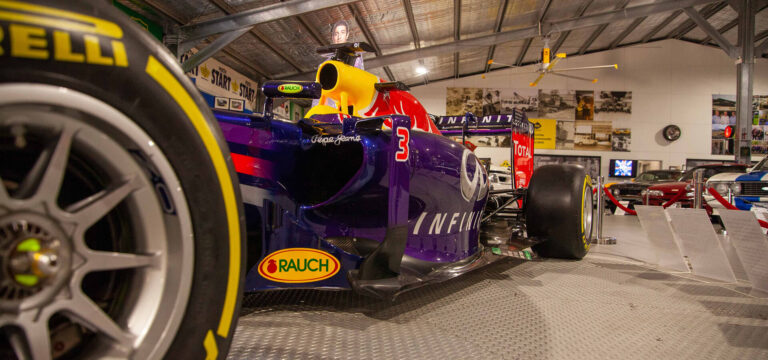
Red Bull F1 Racing Car
Daniel Ricciardo’s very generous offer to favour the Motor Museum with a long term loan of Red Bull RB 10, the car..
-

1963 Triumph TR4
Discover the 1963 Triumph TR4, a Michelotti-designed British sports car in original Spa White. On display for a limited time.