 We're open every day from 10 AM to 4 PM!


1967 MGB Mk I
A British Sports Car with an Australian Story
On display for a limited time at the Motor Museum of Western Australia

A classic British sports car, a distinctive white finish and a fascinating connection to Australia’s automotive manufacturing history. This 1967 MGB Mk I is now on display for a limited time at the Motor Museum of Western Australia, offering visitors the opportunity to get up close with one of the most recognisable sports cars of its era.
Introduced in 1962, the MGB quickly established itself as a favourite among sports car enthusiasts. With its attractive styling, lively 1.8-litre engine and engaging driving character, it brought the enjoyment of open-top motoring to a broad audience. More than just a weekend sports car, the MGB was designed to be practical enough for everyday use, helping it earn a lasting place in British and Australian motoring history.
But the story of this 1967 MGB goes beyond its British origins. It also connects to a period when Australia had a thriving automotive assembly industry, with locally assembled vehicles combining overseas engineering with Australian manufacturing and components.
A Modern Classic Is Born

By the early 1960s, MG had established a strong reputation for building enjoyable, accessible sports cars. The MGB arrived in 1962 as the successor to the MGA, bringing a more modern design and a number of important engineering changes.
Unlike the MGA’s separate chassis construction, the MGB adopted monocoque construction, in which the body itself forms a major part of the vehicle’s structural framework. This helped create a more rigid, modern platform while making efficient use of space. The result was a sports car that felt contemporary for its time without losing the character that had made MG famous.
The MGB’s styling was clean and purposeful, with flowing bodywork, a low profile and proportions that remain instantly recognisable today. Its design balanced sporting appeal with practicality, helping it attract not only dedicated enthusiasts but also motorists looking for something distinctive and enjoyable to drive.
The model was offered in several forms during its production life. The original open-top roadster became the best-known version, while the MGB GT, introduced in 1965, added a fixed roof and a stylish rear hatch. Designed with a more enclosed grand touring character, the GT offered extra versatility while retaining the MGB’s sporting identity.
The MGB would go on to become one of MG’s most successful models. Production continued in the United Kingdom until 1980, with more than half a million examples produced across the MGB family.
Refining a Winning Formula
By 1967, the MGB had undergone several running improvements since its introduction. These developments reflected MG’s efforts to refine the car while retaining the straightforward mechanical character and enjoyable driving experience that had made it popular.
The 1967 MGB Mk I on display is fitted with a five-main-bearing engine, an important development in the evolution of the MGB’s four-cylinder powerplant.
Earlier MGB engines used a three-main-bearing arrangement, while the revised engine introduced in late 1964 used five main bearings to provide additional crankshaft support. This was an important mechanical development as the model matured.
The MGB’s 1.8-litre, four-cylinder engine became a defining part of its character. Rather than relying on sheer power, the car delivered an engaging combination of accessible performance, usable torque and a relatively simple mechanical layout. Its traditional engineering also helped make the MGB an approachable sports car for owners who enjoyed maintaining and understanding their vehicles.
The gearbox is another important part of the MGB story. The early MGB used a four-speed manual transmission with synchromesh on second, third and fourth gears, while first gear was unsynchronised. A fully synchronised four-speed gearbox arrived with the later Mk II generation in late 1967, as part of the model’s continuing development.
The transition between the Mk I and Mk II can be particularly interesting to classic car enthusiasts because the changes did not occur identically across every market. Australian-assembled vehicles followed their own production sequence, making the history of individual cars an important part of understanding their specifications.
A British Design with an Australian Connection
Although the MGB was developed in England, it became part of Australia’s own motoring story through local assembly.
Australian assembly began in April 1963 at the Pressed Metal Corporation plant in Enfield, New South Wales. Vehicles were assembled using completely knocked down, or CKD, kits supplied from the United Kingdom. Rather than arriving as fully assembled cars, these kits allowed vehicles to be put together locally, supporting Australia’s automotive manufacturing industry and its local-content arrangements.
The process involved more than simply unpacking and assembling imported components. A range of parts and materials could be sourced locally, contributing to the Australian manufacturing supply chain. The MGB was therefore an example of how an internationally recognised model could be adapted to the requirements of a different market.
The Australian story is particularly interesting because local production did not always mirror changes made at the British factory. Assembly arrangements, component availability and the timing of specification changes meant Australian cars could differ in detail from their British counterparts.
For enthusiasts, these differences are part of what makes Australian-assembled MGBs worthy of closer study. Identifying a vehicle’s precise specification can involve examining its identification plates, body numbers, engine details and other surviving evidence.
Overdrive and the Evolution of the Australian MGB
One of the more interesting developments in the Australian MGB’s later Mk I period was the availability of overdrive on some cars from late 1967.
On the MGB, the optional overdrive system could operate on third and fourth gears. It provided an additional degree of flexibility without requiring a completely different gearbox, and it became a desirable feature for drivers who regularly travelled at higher speeds.
However, the introduction of overdrive and other transmission changes varied according to production period and market. The early three-synchromesh gearbox, for example, was distinct from the later fully synchronised unit introduced with the Mk II. Not every 1967 MGB had the same combination of equipment.
These details illustrate how the MGB developed over time, with incremental improvements helping to keep the model competitive while retaining its familiar character.
The End of Local Assembly
For nearly a decade, the MGB was assembled in Australia, becoming part of the country’s wider automotive landscape during a period of significant industrial change.
Local assembly continued into 1972, when changing local-content requirements and manufacturing economics contributed to the end of Australian production. By November that year, local assembly of the MGB had ceased.
The end of Australian assembly did not mark the end of the MGB itself. Production continued at the MG factory in Abingdon, England, until October 1980. By then, the MGB had established a worldwide following, with more than half a million cars produced across its various versions.
Today, the model is remembered not only for its British design and engineering but also for the role it played in countries such as Australia, where locally assembled examples became part of everyday motoring life.
The Australian production story is a reminder that the history of a car does not stop at the factory gate. It also reflects the industries, workers, suppliers and communities that helped bring it to local roads.
Why the MGB Remains a Classic


More than six decades after its introduction, the MGB continues to attract enthusiasts for its combination of attractive styling, approachable mechanical design and enjoyable sports car character.
Its proportions are unmistakably of their era, yet the design has aged gracefully. The simple, purposeful bodywork and familiar MG styling cues give it a timeless appeal, while the traditional four-cylinder engine and manual gearbox offer a direct connection to a different period of motoring.
The MGB also represents an important stage in the development of the accessible sports car. It demonstrated that a car could offer genuine sporting character without becoming impractical or exclusive. For many owners, it was a car to be driven and enjoyed rather than simply admired.
Its long production life and worldwide popularity have also created a strong community of owners, restorers and historians who continue to document the model’s many variations. Australian-assembled cars add another layer to that story, reflecting the country’s own manufacturing history and the particular details that distinguish locally produced vehicles.
For visitors to the Motor Museum of Western Australia, the 1967 MGB Mk I offers an opportunity to explore these themes through a real vehicle rather than simply reading about them.
On Display For A Limited Time
Please note that many of the vehicles displayed at the Motor Museum of Western Australia are on loan to us from private collectors and enthusiasts.
Our displays change regularly to showcase a wide variety of vehicles and motoring history, so if you want to experience these rare and extraordinary cars in person, we encourage you to visit us soon.
Whether you are a passionate car lover or simply curious about automotive heritage, the Motor Museum offers a unique and engaging experience that evolves throughout the year.
Visit Us
For more information about visiting the Motor Museum of Western Australia, including opening hours, ticket prices, and current exhibitions, please visit our Visitor Information page or contact us directly.
We are open every day from 10 AM to 4 PM (closed Christmas Day) at Whiteman Park, 233a Drumpellier Drive, Whiteman, WA 6068.
Tickets can be purchased online for your convenience or directly at the museum entrance.
For enquiries, group bookings, or special events, please call us on (08) 9249 9457 or email manager@motormuseumwa.com.au.
We welcome visitors of all ages and motoring interests and look forward to sharing Western Australia’s rich automotive history with you.
Discover More
-
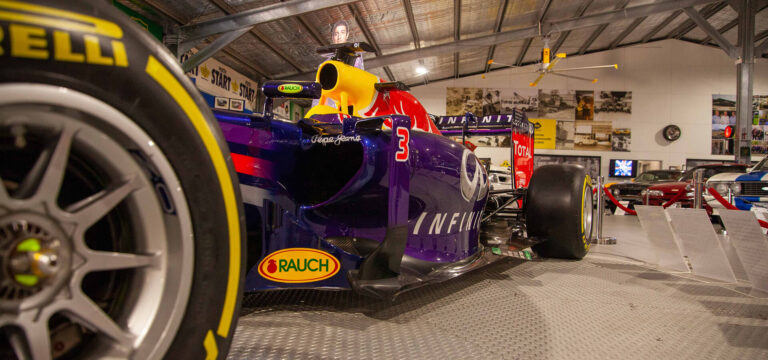
Red Bull F1 Racing Car
Daniel Ricciardo’s very generous offer to favour the Motor Museum with a long term loan of Red Bull RB 10, the car..
-

1970 Rolls-Royce Silver Shadow
Step behind the wheel of a 1970 Rolls-Royce Silver Shadow and experience the luxury, craftsmanship and engineering of one of Britain’s most prestigious motor…
