 We're open every day from 10 AM to 4 PM!


The Legend of the Holden Torana
In the early 1970s, the Holden LJ Torana GTR XU‑1 became the car that every young Australian enthusiast dreamed of owning, combining compact size, raw six‑cylinder power and a direct connection to Bathurst and Peter Brock.
Today it stands as one of the most recognisable Australian performance cars, and a powerful symbol of Holden’s golden era on both road and track.

Beyond the bare statistics, the GTR XU‑1 represents a uniquely Australian form of performance car: something that could carry mates during the week, head to the drags or a hillclimb on the weekend and, in racing trim, tackle Mount Panorama.
That blend of practicality and hero status helped it lodge itself firmly in the national memory long after production ended and Holden itself disappeared from new‑car showrooms.
Every Young Australian’s Dream Machine
For many young drivers in the early 1970s, the Torana GTR XU‑1 was the poster car pinned to bedroom walls, parked outside milk bars and roaring away from traffic lights in a haze of tyre smoke and induction roar.
It looked tough without being enormous, with its flared and fluted guards, sports wheels and bold striping announcing that this was something special even to people who knew little about cars.
That desirability was fuelled by what was happening at Mount Panorama.
Seeing Peter Brock and the Holden Dealer Team take on bigger, more powerful Fords in what was then the Hardie‑Ferodo 500 gave young fans the sense that owning a Torana—especially a GTR or XU‑1—was a direct line to the drama and glory of Bathurst.
Local motoring magazines and newspapers played their part too, running road tests that praised the car’s nimble handling and lively engine, and filling their pages with images of brightly coloured Toranas carving through corners on Australian roads and racetracks.
Reality, of course, complicated the dream. Insurance companies quickly recognised that XU‑1s were attracting enthusiastic young drivers, and premiums for GTR and XU‑1 models became notoriously steep, especially for under‑25s.
Stories circulated of parents refusing to sign on the dotted line, of would‑be owners forced into lesser models, and of lucky few who managed to scrape together the money and live the dream, which only added to the Torana’s legend as a car that was both coveted and just slightly out of reach.
From Viva Roots to True Aussie Muscle
The Torana story began in 1967 with a compact car derived from the British Vauxhall Viva, adapted by Holden to cope with Australian roads and climate. Those early four‑cylinder cars filled a gap below the larger Kingswood in Holden’s lineup, offering buyers a smaller, more economical alternative that still wore the lion badge.
Yet even then, Holden engineers and marketers could see potential for something more than just basic transport.
By the time the LC and then the LJ series arrived in 1970–1972, the Torana had been thoroughly localised.
Longer‑wheelbase variants allowed a six‑cylinder engine to be fitted, giving the car the kind of punch Australian buyers expected, and the styling evolved with a new front end influenced by the HQ Holden that gave the LJ a sharper, more confident look.
The name “Torana”, widely believed to come from an Aboriginal word meaning “to fly”, suddenly seemed especially appropriate as the car’s performance and ambitions took off.
As the range broadened, buyers could choose from humble four‑cylinder commuters, mid‑range six‑cylinder family cars and, at the top of the tree, sports models like the GTR and GTR XU‑1. This flexibility helped cement the Torana in Australian life; it could be a first car, a company hack, a rally weapon or a race winner, sometimes all within the same extended family.


Inside the LJ GTR XU‑1
The GTR badge first appeared on the six‑cylinder Toranas as a way for Holden to tap into the growing appetite for compact performance cars. In the LC generation, the GTR used a tuned 2.6‑litre “161” six from the Belmont, with modified cylinder head, camshaft, exhaust and carburettor, all wrapped in a lighter, more agile body than a full‑size Holden sedan. That combination of strong mid‑range torque and relatively low weight gave the car a lively feel that endeared it to keen drivers and motoring journalists alike.

The XU‑1 package turned the wick up further.
In LJ form it gained a 202 cubic‑inch (3.3‑litre) six‑cylinder engine breathing through three Zenith‑Stromberg CD‑175 carburettors, with a performance‑tuned head and camshaft and a new close‑ratio Australian‑built four‑speed manual gearbox. Power climbed to around 190 bhp (142 kW) in race‑bred form, and a taller 3.08:1 final drive ratio on the so‑called “Bathurst Special” helped the car reach about 135 mph (217 km/h) down Conrod Straight, crucial for challenging the mighty Falcon GT‑HO Phase III.
Chassis and braking upgrades ensured the XU‑1 could use this extra urge effectively.
Standard front disc brakes, wider steel rims, an under‑body front air dam, a rear spoiler and tailored suspension tuning all contributed to high‑speed stability and cornering grip.
Inside, the car received sports seats and a distinctive six‑gauge instrument cluster, derived from the Monaro, which gave the driver comprehensive information at a glance and reinforced the sense of driving something special. Enthusiast resources such as Unique Cars and Parts and specialist Torana histories detail these changes in depth and underline how thoroughly the GTR XU‑1 was engineered for serious driving.
The 1973 Holden Torana LJ GTR XU‑1 at the Motor Museum of Western Australia showcases many of these defining features. Finished in Sebring Orange—a standout Torana colour of the period—it pairs its bright exterior with antique dark brown trim and leather inserts, capturing the bold interior palettes popular in early‑1970s Australian performance cars.
Under the bonnet is a NASCO GMH block with a 202 motor, backed by an XU‑1 specification gearbox and fed by triple Stromberg carburettors, driving through a limited‑slip differential to widened wheels with 9½‑inch rims at the rear and 8½‑inch rims at the front.
Holden, Bathurst and the Birth of a Giant Killer
At the start of the 1970s, Australian touring car racing was dominated by big‑capacity V8s like Ford’s Falcon GT‑HO and Holden’s own Monaro GTS. These cars were fast and spectacular, but they were also heavy, and the escalating “arms race” in power and speed brought increasing scrutiny from media, politicians and safety advocates concerned about similar cars being sold to the public. In this climate, Holden’s decision to develop a smaller, lighter Bathurst challenger based on the Torana was both a racing strategy and a clever response to changing attitudes.
Under Harry Firth’s leadership, the Holden Dealer Team treated the LC and LJ GTR XU‑1s as thoroughbred competition cars. Development focused on critical areas for endurance racing: engine durability and flexibility, braking performance, fuel consumption and handling balance over long stints at high speed. The result was a package that might not have matched the Falcon GT‑HO’s raw straight‑line muscle, but could carry tremendous speed over the top of the mountain and place less strain on its tyres and brakes over the course of 500 gruelling miles.
This focus on brains over brute force fundamentally reshaped the Australian touring car landscape. The XU‑1 showed that a well‑sorted six‑cylinder car could challenge and even beat the most powerful V8s on the country’s toughest circuit, influencing later design decisions for both Holden and its rivals. At the same time, mounting concern over high‑performance road cars led to the “supercar scare”, a media and political backlash that pressured manufacturers to abandon their most extreme production specials. The GTR XU‑1, and particularly the Bathurst‑spec LJ, stands at the high‑water mark of that era, a car built just before the tide turned toward more regulated, less overtly race‑oriented road vehicles.
Peter Brock, Bathurst and the XU‑1 Legend
The single most important chapter in the XU‑1’s story unfolded at the 1972 Hardie‑Ferodo 500 at Bathurst. In appalling, rain‑soaked conditions, a young Peter Brock drove his Holden Dealer Team LJ XU‑1, car 28C, solo for the entire race, out‑lasting and out‑manoeuvring Allan Moffat’s Falcon GT‑HO Phase III and a field full of larger V8‑powered rivals. It was a triumph of consistency, car control and race strategy, and it instantly turned Brock into a national hero while proving the validity of Holden’s “giant killer” philosophy.

That win reverberated far beyond Mount Panorama. Holden showrooms reported increased interest in Toranas, especially GTRs and XU‑1s, as fans sought to bring a little of that Bathurst magic into their own garages. For many people, the image of a compact, brightly coloured XU‑1 sliding through the wet corners of Bathurst, its six‑cylinder singing, became the defining picture of early‑1970s Australian motorsport. The Supercars Championship website has revisited this moment in features like “Saturday Sleuthing: Brock’s Bathurst‑Winning Toranas”, tracing what happened to those race cars and preserving their stories for new generations.
Brock and the Torana would go on to enjoy more success together, particularly with the later LH and LX SL/R 5000 and A9X models, but there is a special purity about the LJ XU‑1 era. It was a time when one driver could still tackle Bathurst solo, when touring cars were visibly linked to the cars on Australian streets, and when a six‑cylinder could credibly topple the biggest V8 in the land. For many enthusiasts, that is why the XU‑1 remains their favourite of all Brock’s Bathurst mounts, even if later cars were faster and more sophisticated.
Toranas, Holdens and Australian Motoring Culture
Away from the spotlight of Bathurst, the Torana became deeply woven into everyday Australian life. Families used four‑cylinder and base six‑cylinder models as daily transport; apprentices and young workers saved hard for GTRs; and backyard mechanics transformed tired old sedans into street machines with transplanted engines and home‑built modifications. The car’s size made it easy to park and live with, while its mechanical simplicity meant that many jobs could be tackled at home with basic tools, strengthening the bond between owners and their cars.
As the model evolved into the LH and LX series, with their larger bodies and optional V8 engines, the Torana name became synonymous with Australian muscle. Iconic variants like the SL/R 5000 and A9X continued the marque’s success in touring car racing and cemented its image as a car for serious drivers. Yet the earlier six‑cylinder GTRs and XU‑1s retained a cult following for their lighter, more agile feel and their close connection to the grassroots of Holden performance history.
Enthusiast clubs and events play a major role in keeping this culture alive. Torana owners’ clubs across Australia organise cruises, show‑and‑shine events and track days, often drawing cars from all eras of production. Museums such as the National Holden Motor Museum and regional collections frequently host Torana displays and themed events, sometimes featuring convoys of classic Holdens arriving en masse to celebrate anniversaries or special occasions. Online resources like Enthusiast.com.au and model‑specific forums document restorations, modifications and survivor cars, ensuring that technical knowledge and personal stories are preserved alongside the vehicles themselves.
Holden’s closure of its Australian manufacturing operations in 2017, followed by the retirement of the brand in 2020, has added a bittersweet note to this enthusiasm. Classics like the LJ GTR XU‑1 are now seen not only as fun, fast cars but as tangible reminders of an industry that once employed thousands and shaped the identity of entire communities. For many visitors, standing beside a Torana in a museum is a way of reconnecting with family histories, road trips, first cars and formative experiences that are bound up with the Holden name.
See the Sebring Orange XU‑1 at the Motor Museum of Western Australia
The Sebring Orange 1973 Holden Torana LJ GTR XU‑1 at the Motor Museum of Western Australia gathers all these threads—engineering, racing, culture and memory—into one compact, muscular package. Its bright paintwork, period‑correct striping and dark brown interior with leather inserts immediately transport visitors back to the early 1970s, when bold colours and tactile materials were part of the appeal of performance motoring. Pop the bonnet and you are greeted by the sight of a triple‑carb 202 six‑cylinder engine, an XU‑1 gearbox and a properly tough limited‑slip differential, all set up to drive those wide rear rims that give the car such a purposeful stance on the museum floor.
For many guests, particularly those who grew up in the Torana era or whose parents and grandparents owned Holdens, this car is a memory trigger. It prompts stories of long‑ago road trips, late‑night drives, paddock‑bashers on farms and the thrill of hearing an XU‑1 on song for the first time. Younger visitors, meanwhile, often recognise the shape from old photos, die‑cast models or modern tributes in magazines and online, and are surprised to discover how compact and focused the real car is compared to modern performance vehicles.
On Display For A Limited Time
Please note that many of the vehicles displayed at the Motor Museum of Western Australia, including this iconic Torana, are on loan to us from private collectors and enthusiasts.
Our displays change regularly to showcase a wide variety of vehicles and motoring history, so if you want to experience these rare and extraordinary cars in person, we encourage you to visit us soon.
Whether you are a passionate car lover or simply curious about automotive heritage, the Motor Museum offers a unique and engaging experience that evolves throughout the year.
Visit Us
For more information about visiting the Motor Museum of Western Australia, including opening hours, ticket prices, and current exhibitions, please visit our Visitor Information page or contact us directly.
We are open every day from 10 AM to 4 PM (closed Christmas Day) at Whiteman Park, 233a Drumpellier Drive, Whiteman, WA 6068.
Tickets can be purchased online for your convenience or directly at the museum entrance.
For enquiries, group bookings, or special events, please call us on (08) 9249 9457 or email manager@motormuseumwa.com.au.
We welcome visitors of all ages and motoring interests and look forward to sharing Western Australia’s rich automotive history with you.
Discover More
-
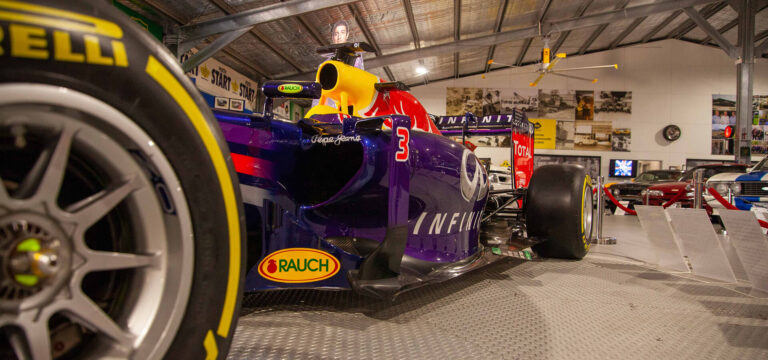
Red Bull F1 Racing Car
Daniel Ricciardo’s very generous offer to favour the Motor Museum with a long term loan of Red Bull RB 10, the car..
-

1961 MGA Roadster
See why this 1961 MGA Roadster is must see when visiting the Motor Museum of Western Australia.